Pentagon Metro Entrance Access Control Point
Pentagon's Busiest Gate Gets Security Overhaul for Peak Traffic
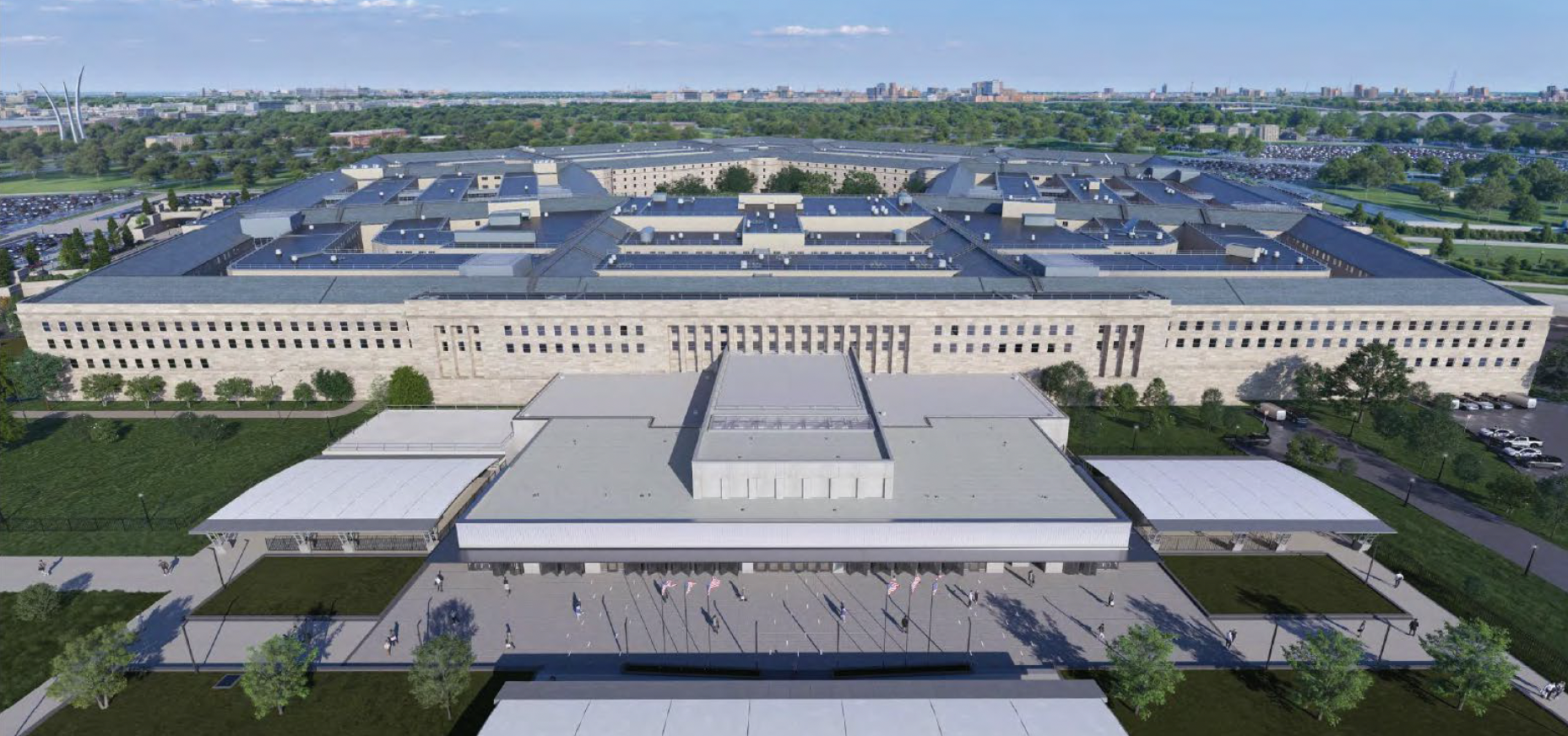
IntegralRSG led protective design for a major security upgrade at the Pentagon’s busiest public entrance—an arrival sequence required to
safely process up to 5,400 occupants per hour while preserving clarity, openness, and ease of movement. Beyond throughput, the project
demanded an architectural response that balanced the gravity of a high-risk control point with a calm and dignified public experience.
As a key design driver, the project team deliberately minimized vertical structural elements within the screening hall. We pursued an open environment that reduced conflicts with screening equipment and security operations while reinforcing intuitive wayfinding and visual transparency. IntegralRSG collaborated closely with the structural engineer to embed structural robustness into a long-span framing strategy, relying on a complex grid while remaining sensitive to foundation load constraints imposed by an active metro tunnel beneath the site. The resulting structure allows the screening hall to read as a single, uninterrupted volume—supporting operational complexity while expressing balanced simplicity.
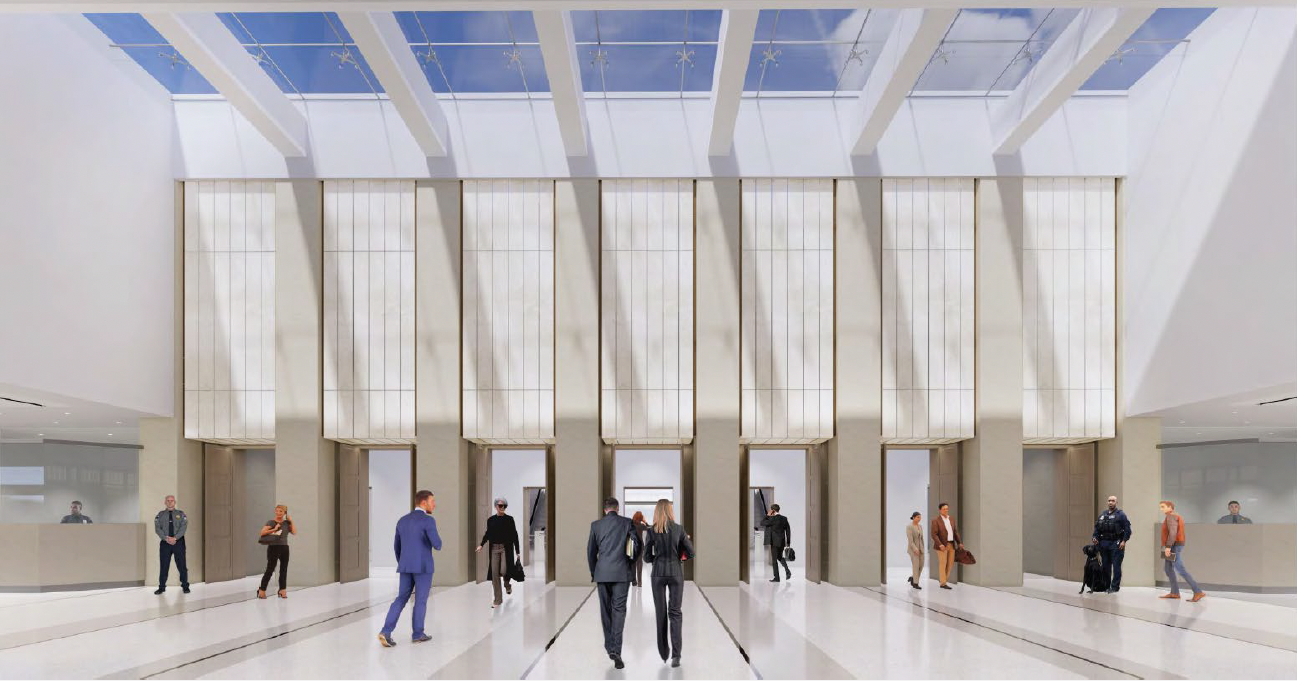
IntegralRSG shaped protective measures not only around public flow, but around those who operate the space every day. We gave particular
attention to enhancing safety for Pentagon Force Protection Agency personnel at this high-risk control point. The solution integrates
layered protection while maintaining clean sight lines and establishing defensible positions that support both safe refuge and effective
threat response.
Working closely with architects, engineers, and PFPA stakeholders, IntegralRSG translated force protection requirements—including
application-specific hardening for IED, ballistic, and forced-entry threats exceeding UFC 4-010-01 minimum standards—into coordinated design
criteria and construction documents. The result is a screening facility that performs under demanding threat scenarios while presenting as a
clear, navigable, and architecturally disciplined space—one where security is embedded in the architecture itself, and the experience of
arrival remains open, legible, and composed.
.png)
| Owner: |
Pentagon Force Protection Agency |
| Size: |
18,000 SF |
| Location: |
Arlington, VA |
| Collaborators: |
HDR |
| Delivery Method: |
Design-Build |